4.4/5· 9 reviews
Drishti Cards Bundle
All three Drishti card sets in one bundle — Ekagrata Focus Cards for attention, Rekha Fabric Cards for pattern recognition, and Progressive High Contrast Cards for colour progression and parts-to-whole thinking. Four distinct areas of vision development, each with the card type built for it.
Real babies, real focus
$25$39.5037% OFF
Shipping $8 to your country, added at checkout. Duties prepaid — nothing to pay on delivery.
Dispatched within 2 business days · tracked delivery
Ships worldwide from IndiaYou save $14.50
$25$39.50+ $8 shipping
Duties and taxes prepaid. Nothing to pay when it arrives.
Card payment only. We do not offer cash on delivery outside India.
Ordered
Shipped
Delivered
Dispatched within 2 business days · Delivery time depends on the shipping partner and destination
100% secure transaction
Replacement if lost or damaged*
Rooted in Indian Knowledge Systems (IKS) & Modern Neuroscience
“My baby stays focused on Drishti products longer than any toy.”
— Aditi, Mumbai
Real babies, real focus
Safe & Non-Toxic
Baby-safe materials
Worldwide Delivery
Tracked, duties prepaid
IKS Rooted
Indian Knowledge Systems
Research-Backed
Vedic + Neuroscience
Three cards · Four ways of seeing
Vision isn't one skill. It's four — and they don't develop together.
Focus, pattern recognition, colour and object structure each mature on their own timeline in the first year. A stack of more black-and-white cards trains one of them repeatedly and leaves the rest untouched. The bundle gives each area the card type built for it — Ekagrata for attention, Rekha for pattern, and the Progressive cards for colour and parts-to-whole thinking.
The four areas — and why each one matters now
The first twelve months are when each of these abilities is actively being built. What a baby is given to look at during that window is what their visual brain practises on.
01
Strongest from 6 weeksEkagrata
Sustained focus
Before a baby can recognise anything, they have to be able to hold their eyes on it. Looking starts as reflex-like alertness around 6 weeks, becomes active scanning at 8–10 weeks, and only turns into genuine sustained engagement from about 12 weeks.
Look duration is not a straight line upward — it rises to around 2 months, dips between 3 and 6 months as babies get quicker at disengaging, then climbs again from 6 months as voluntary, top-down attention comes online. Sustained attention in infancy is associated with later self-regulation and social communication, which is why it is worth practising deliberately rather than leaving to chance.
Built by Ekagrata Focus Cards
02
Transforms between 4 and 9 weeksRekha
Pattern recognition
Patterns are how a baby learns that the visual world has structure. But a newborn can only see a pattern if its contrast is bold enough and its elements are large enough — fine detail is genuinely invisible at first.
Overall contrast sensitivity multiplies four to five times between roughly 4 and 9 weeks: the contrast a baby needs to detect a bold pattern drops from around 7% at 2–3 weeks to about 0.5% by 9 weeks. After that, sensitivity to broad shapes plateaus while sensitivity to fine detail keeps climbing through the first year. Babies need bold, widely-spaced patterns early and finer, more intricate ones later — in that order.
Built by Rekha Fabric Cards
03
Unfolds from birth to 6 monthsVarna
Colour progression
Colour vision is not switched on at birth. It arrives in a fixed order, and showing a two-week-old a full-spectrum rainbow is closer to noise than stimulation.
Chromatic discrimination is poor at birth and matures over the first months in sequence: red becomes discriminable in the first weeks, blue and yellow around 2–3 months, green around 4–5 months, with broadly adult-like basic colour vision by 5–6 months. Cards that follow this order — black and white first, then a single warm colour, then softer full colour — meet the eye where it actually is.
Built by Progressive High Contrast Cards
04
Rapid transition at 2 to 4 monthsSamrachana
Parts-to-whole thinking
The biggest leap of the first year is not seeing more — it is seeing that separate parts belong to one whole. That is the difference between looking at shapes and recognising things.
Newborns can already perceive a centre-occluded object as one connected unit when its visible parts move together. The ability emerges in simpler displays by around 2 months and is robust by 4 months even when the occluder is large, making 2–4 months a rapid transitional window. By 4 months infants use the global form of a partly hidden object to work out what it is. Cards whose elements progressively connect into a single scene give the brain exactly this practice.
Built by Progressive High Contrast Cards
Developmental timings above summarise published research on infant visual attention, contrast sensitivity, colour discrimination and perceptual completion. Every baby develops at their own pace — these are typical windows, not deadlines.
What's in the Bundle
Three card sets, each doing a job the other two can't.
 Focus
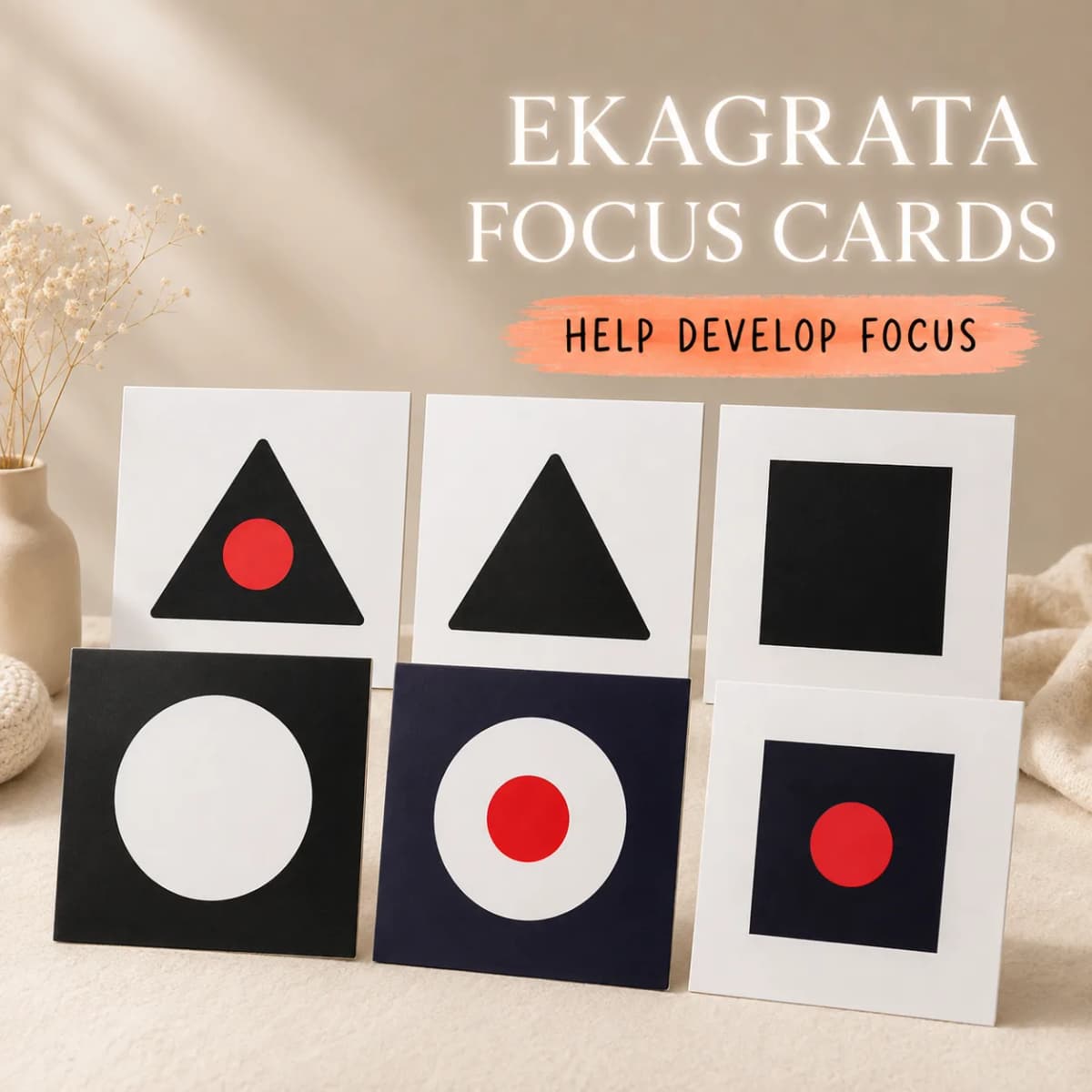
FocusEkagrata Focus Cards
Two-sided cards that lead the eyes to basic forms first, then to one single focal point with nothing competing around it — the cleanest way to practise holding a gaze.
- One focal point per card — no visual clutter
- Builds the attention every other visual skill rests on
- Bundle-exclusive — not sold separately
Bought alone: $2.50
 Pattern
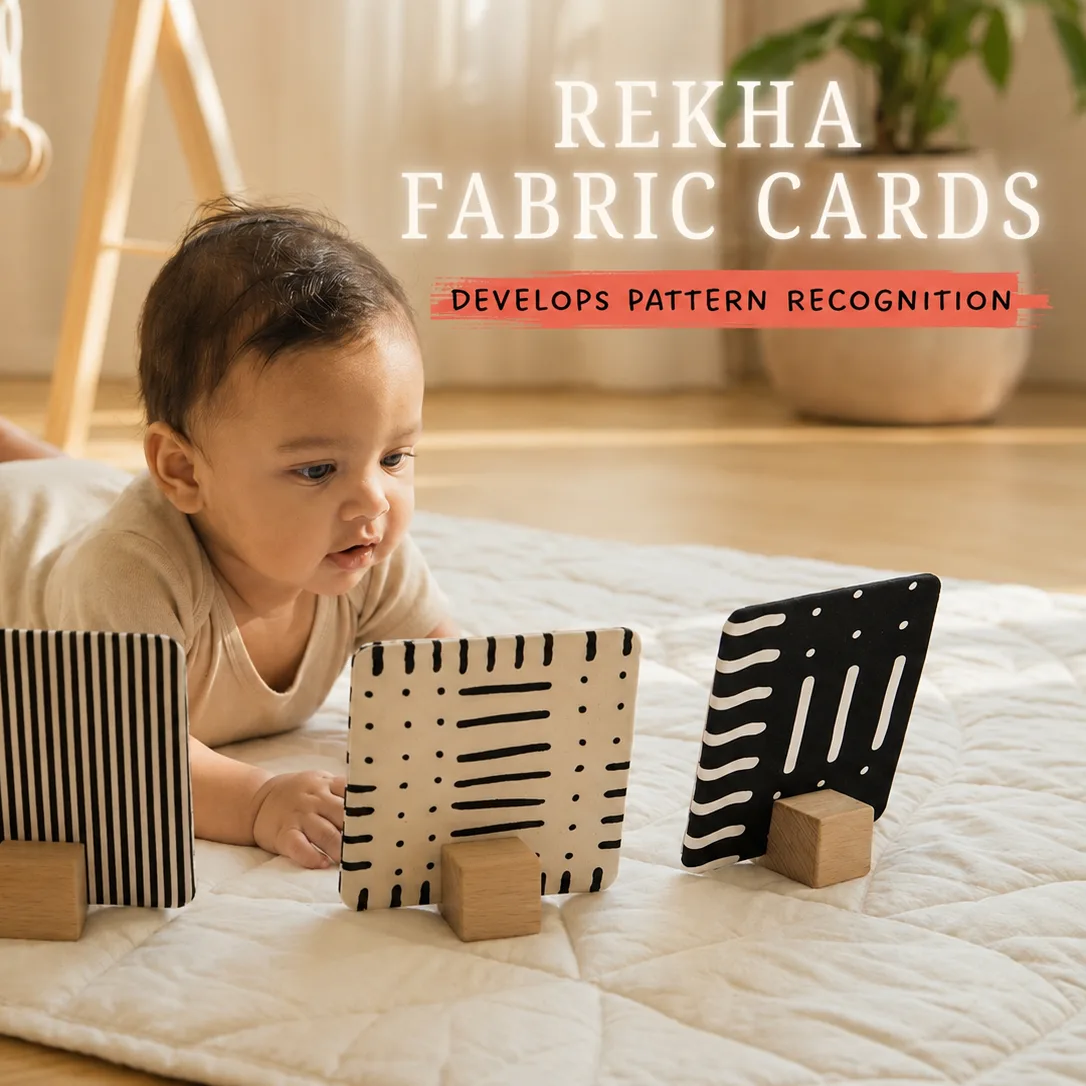
Rekha Fabric Cards
Six soft cotton cards in bold line families — stripes, waves, dots and grids — printed at the scale a young baby can actually resolve, and soft enough to hold.
- Bold, widely-spaced patterns for early contrast sensitivity
- Engages touch and sight at the same time
- Crinkle-free cotton — ideal for tummy time
Bought alone: $19View details →
 Colour + Structure
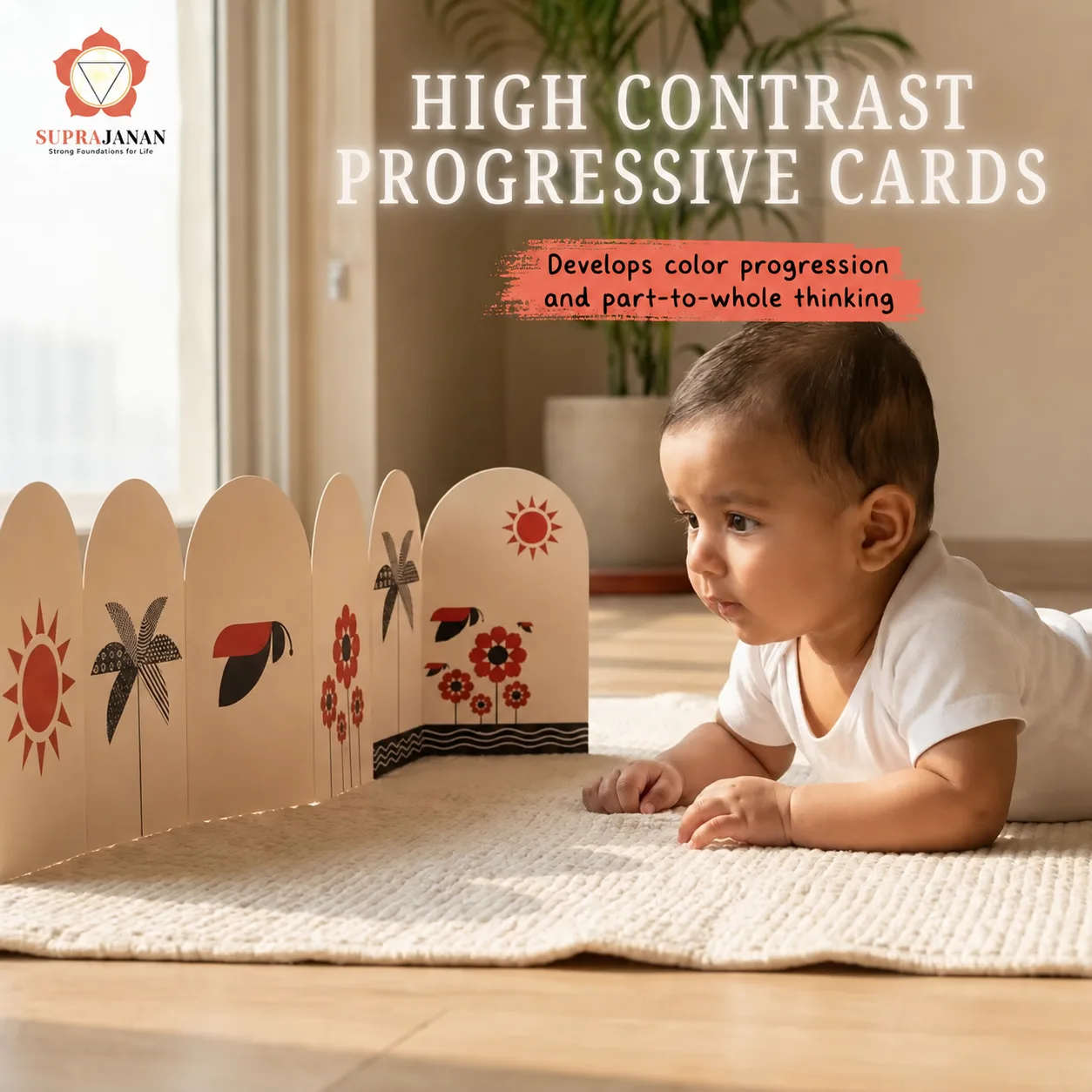
Progressive High Contrast Cards
Two-sided cards that grow with your baby: side one for 0–6 months, side two for 6–12 months, with four elements that connect across the final leafs into one story.
- Side one 0–6 months, side two 6–12 months
- Follows the real order colour vision develops in
- Elements assemble into a whole — parts-to-whole practice
Bought alone: $18View details →
All three, side by side
These aren't three stages to move through one after another — all three sets stay in rotation across the whole first year, because the abilities they build develop in parallel. What changes is the emphasis, and which side of the Progressive cards is facing up.
0–3 months
Hold a gaze, detect bold contrast
- Ekagrata
- Single focal point, held 20–30 cm away — the main work at this age.
- Rekha
- The boldest stripes and dots, propped up for tummy time.
- Progressive
- Side one, a few leafs at a time.
3–6 months
Compare patterns, notice the first colours
- Ekagrata
- Bring in the red-accent cards as focus targets.
- Rekha
- Rotate through the line families; the red card lands around 5 months.
- Progressive
- Still side one — follow the elements as they connect.
6–12 months
Connect parts into wholes, track finer detail
- Ekagrata
- Let your baby hold and turn the cards themselves.
- Rekha
- Fabric cards for grasping, texture and quiet exploration.
- Progressive
- Flip to side two and work through the full story.
Bundle & Save
$25$39.5037% OFF
Ekagrata Focus Cards ($2.50) + Rekha Fabric Cards ($19) + Progressive High Contrast Cards ($18) come to $39.50 separately. Together in the bundle, they're $25 — a saving of $14.50.
Rooted in Indian Knowledge Systems and modern neuroscience — handcrafted in India.
Handcrafted in IndiaBaby Safe MaterialsEco Conscious
What Parents Are Saying
4.4
9 Reviews
from verified buyers
Shruti Kulkarni
VerifiedPune, India
The fabric quality is beautiful — so soft and the patterns are crisp. My 2-month-old lies on her tummy staring at the striped card for a full 10 minutes. Finally something that holds her attention without being a screen.
Pooja Deshmukh
VerifiedNagpur, India
Beautiful designs with a clear purpose. The two-sided progression really works — our daughter loved the high-contrast side early on and now responds so well to the soft colours at 8 months.
Aparna Rao
VerifiedBangalore, India
Love that these are cotton and not plastic. No crinkle sound, just pure visual play. The red-and-white polka dot card was the first one my son really locked eyes on — exactly around 5 months like the guide said.
Swati Verma
VerifiedKolkata, India
Bought this as a trial before getting the full Drishti Kit. Loved it so much we ordered the kit immediately! The cards are genuinely well-researched.
Frequently Asked Questions
We dispatch within 2 business days. Delivery time after that is set by our shipping partner and varies by destination, so we cannot guarantee an arrival date, but your parcel is tracked the whole way and you get the tracking link by email when it ships. Duties and taxes are prepaid, so there is nothing to pay when it arrives.
We ship worldwide from India. Each item has a fixed shipping charge, shown before you pay. Outside India we take card payment only — there is no cash on delivery.
No. International orders are prepaid in full, including shipping, and all international sales are final: we do not accept returns or offer refunds on them, including the shipping charge. If your parcel is lost in transit or arrives damaged, we will send a replacement once you give us proof: photos within 7 days of delivery for a damaged parcel, or the shipping partner's confirmation that a parcel is lost.
Drishti Cards Bundle
$2537% OFF · No code
Related Articles
You May Also Like
0 – 12 Months
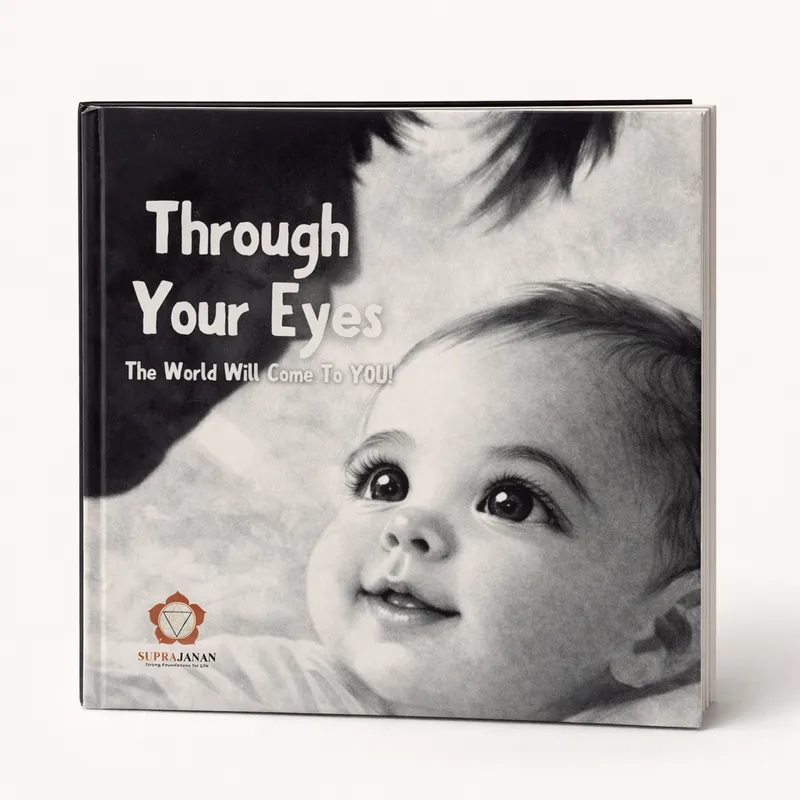
Through Your Eyes
A high-contrast story book designed for newborns — connecting auditory and visual pathways as baby hears while they see. Builds early language foundations through rhythm and repetition.
$15
Pregnancy · 9 Months
Likhit Gita
30 curated shlokas from the Bhagavad Gita — 5 for each pillar of the D.H.A.R.M.A. Framework™ — with meanings, modern lessons, and guided writing space. A sacred Garbh Sanskar practice that nurtures your child's holistic growth from the womb.
$26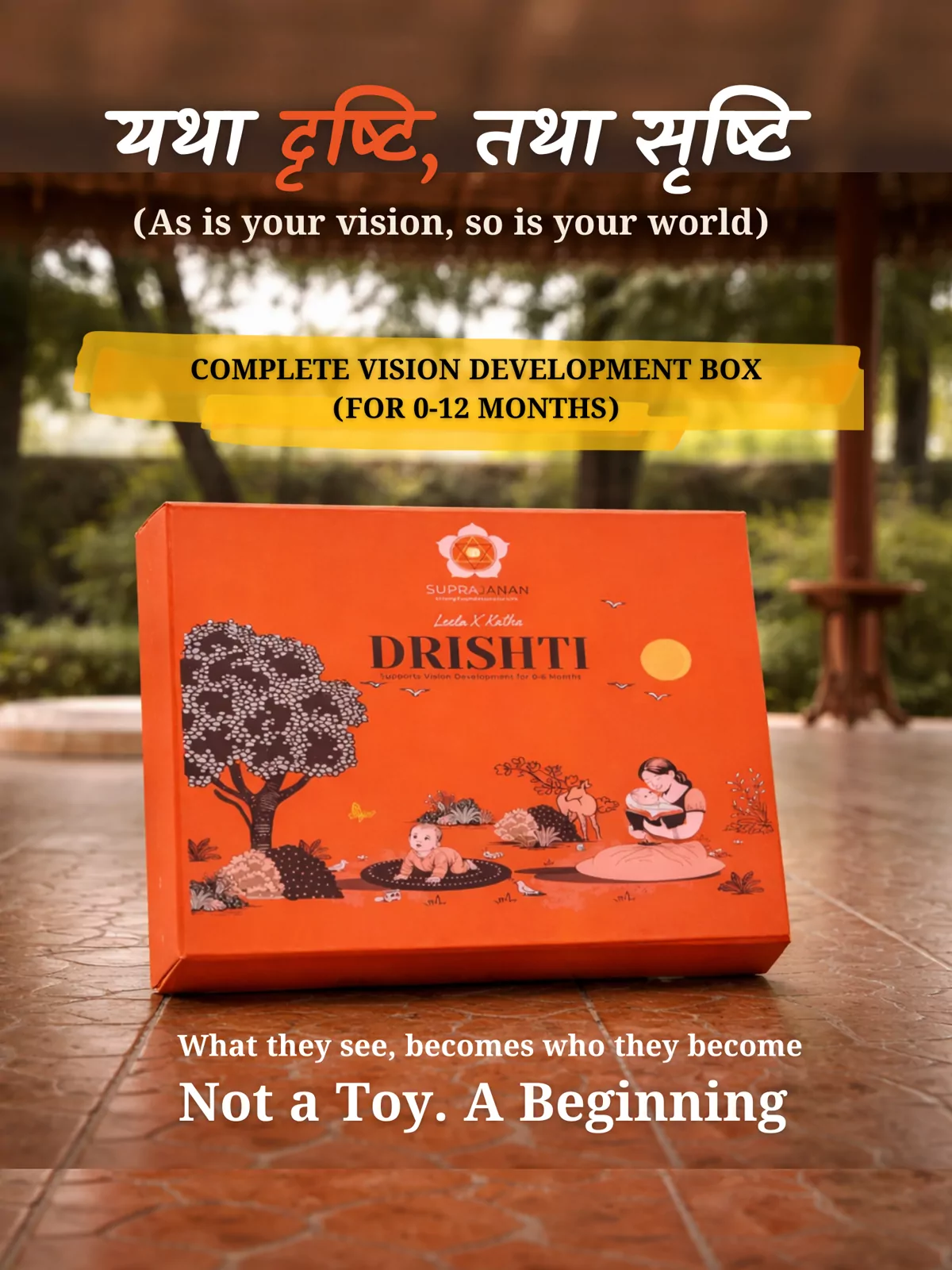
0 – 12 Months
Drishti Kit
Unlike most early-vision toys that add more to see, Drishti teaches babies how to see — slowly, clearly, and with focus. Blends Vedic principles of attention with modern neuroscience of infant visual development.
$49
Pregnancy – 12 Months
Drishti Kit + Likhit Gita Combo
The complete journey from womb to world — the Likhit Gita Garbh Sanskar journal to bond with your baby before birth, paired with the Drishti Kit to guide their vision through the first year. One gift for the whole beginning.
$69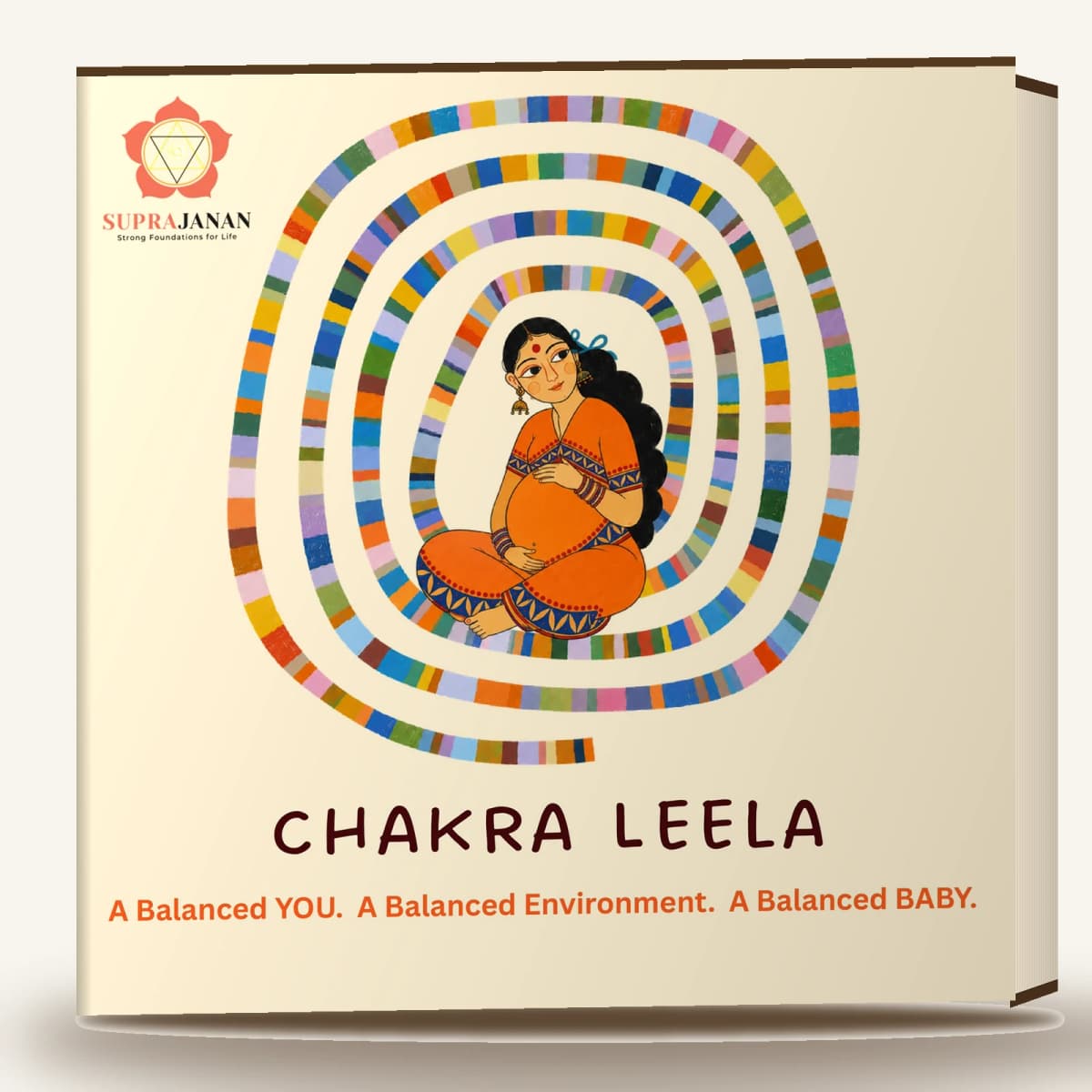
Pregnancy
Chakra Leela
A pregnancy practice that balances your seven chakras, so your baby grows in the most balanced environment. Write the beej mantra, chant the seed sound, colour the yantra — ten minutes a day, no teacher and no experience needed.
$27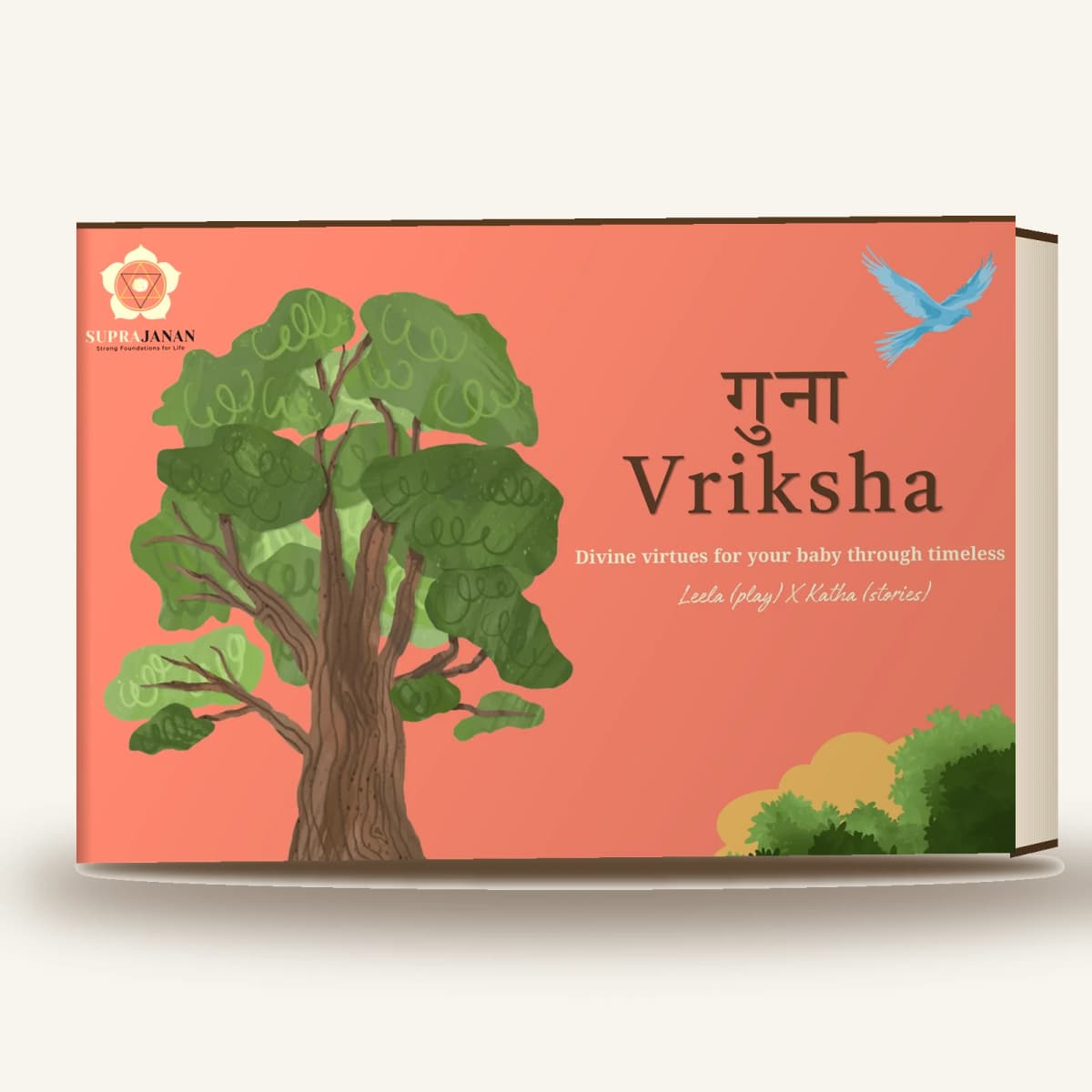
Pregnancy
Guna Vriksha
A read-aloud book for both parents. Eighteen virtues, each opening with a story from our epics and closing with something small you do together — a blessing spoken to the bump, a verse chanted softly, a family name added to your virtue tree.
$26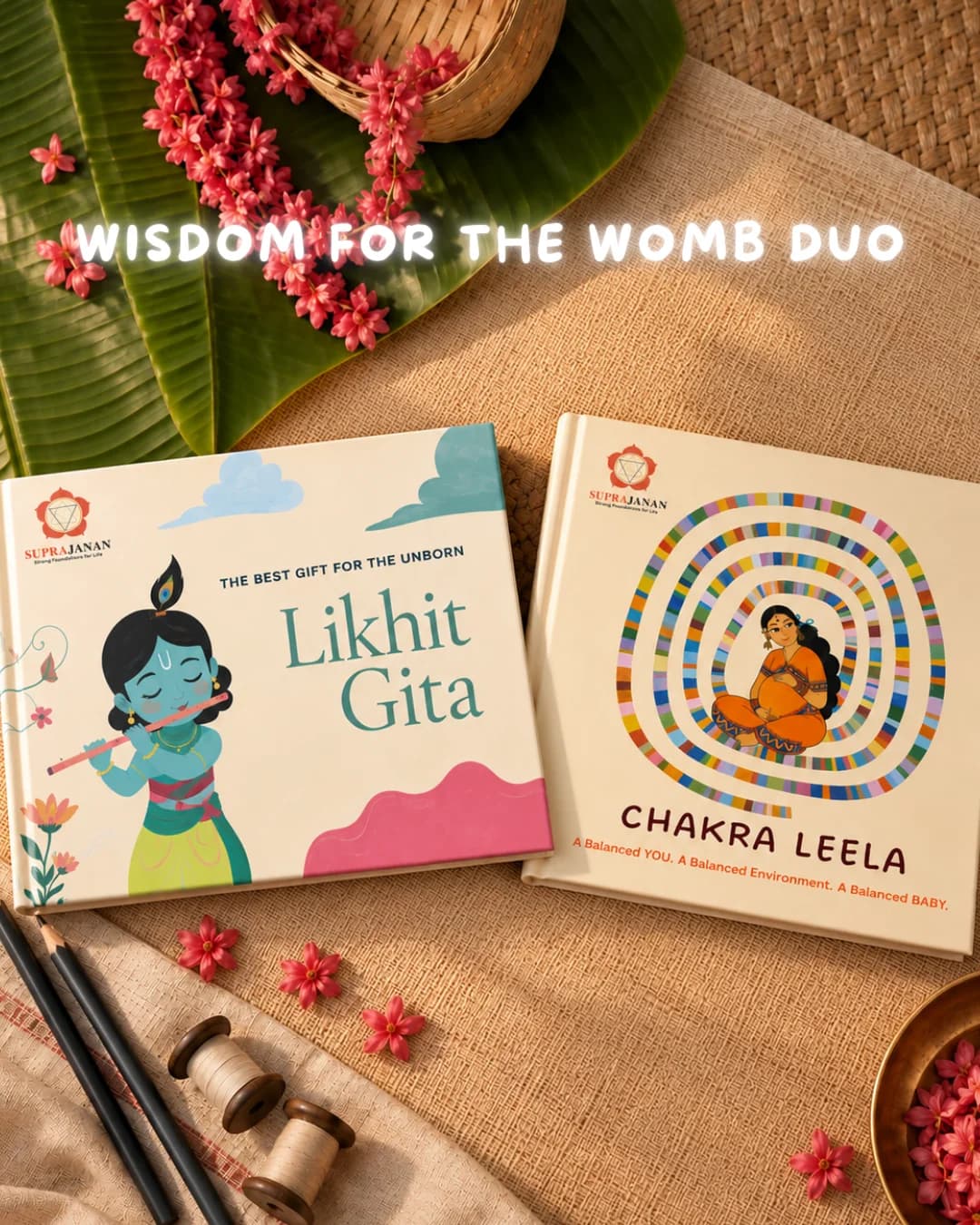
Pregnancy
Wisdom for the Womb Duo
Two ten-minute practices for the same pregnancy — write 30 Bhagavad Gita shlokas in the Likhit Gita, and balance your seven chakras with Chakra Leela. Both books together at the best price we offer them.
$42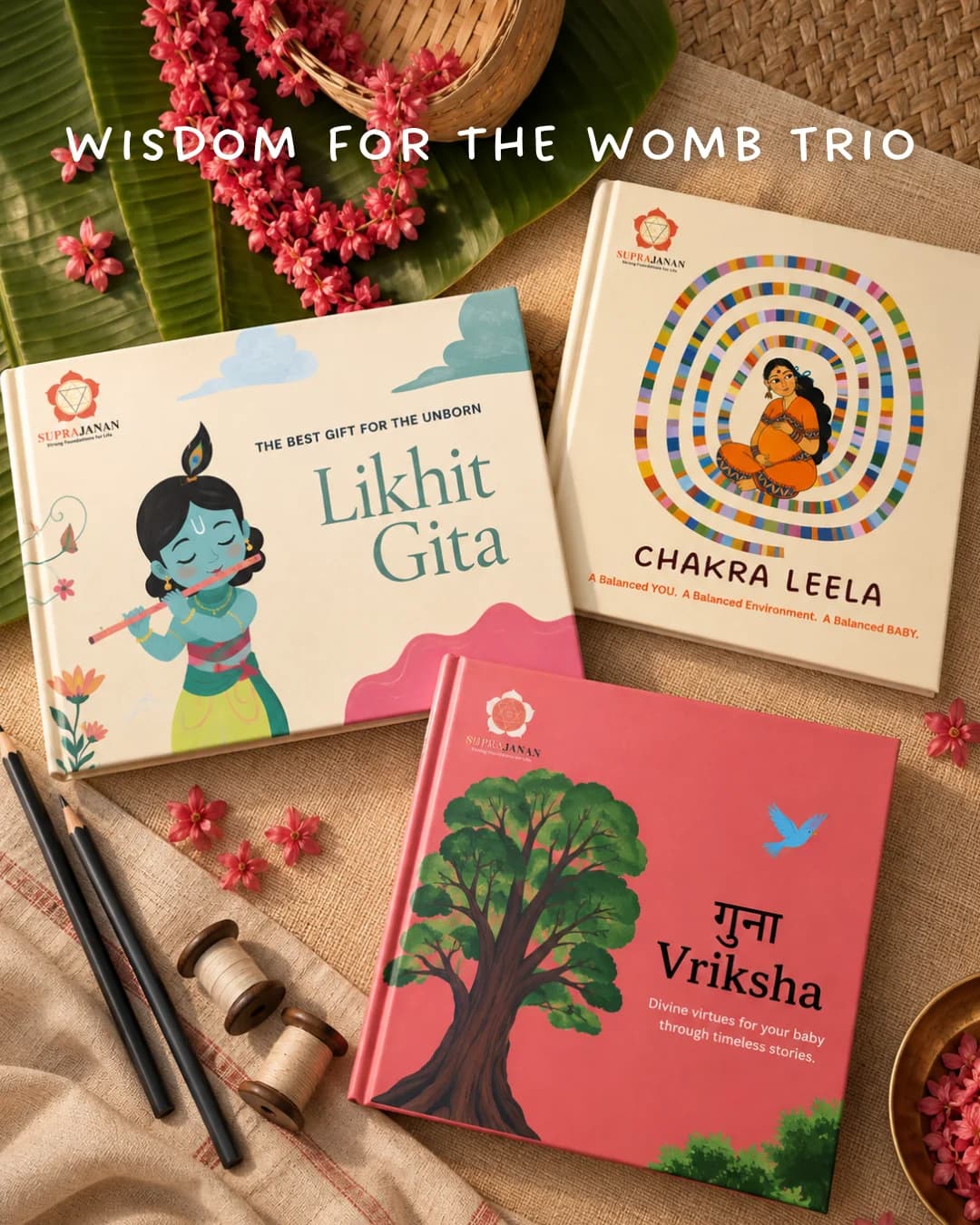
Pregnancy
Wisdom for the Womb Trio
Wisdom for the womb, on one shelf — write the Gita in your own hand, balance your seven chakras, and read eighteen virtues aloud with Papa. Three ten-minute practices that carry a pregnancy, together at the best price we offer them.
$58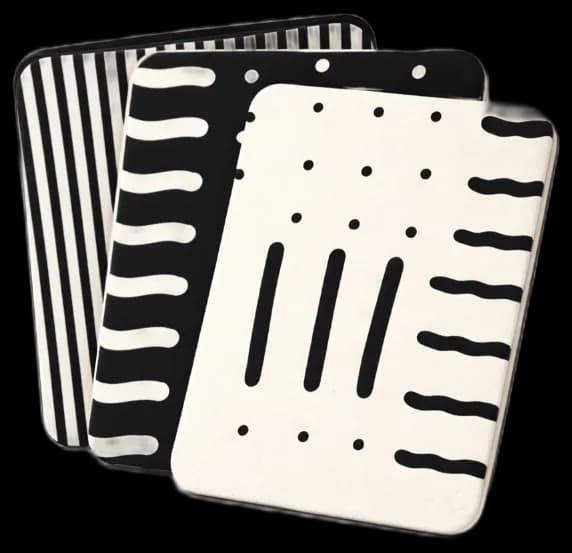
0 – 6 Months
Rekha Fabric Cards
Six soft cotton cards in bold Rekha (line) patterns — stripes, waves, dots and grids — that engage touch and sight together. High contrast without overstimulation. Gentle on tiny hands, rich in visual meaning.
$19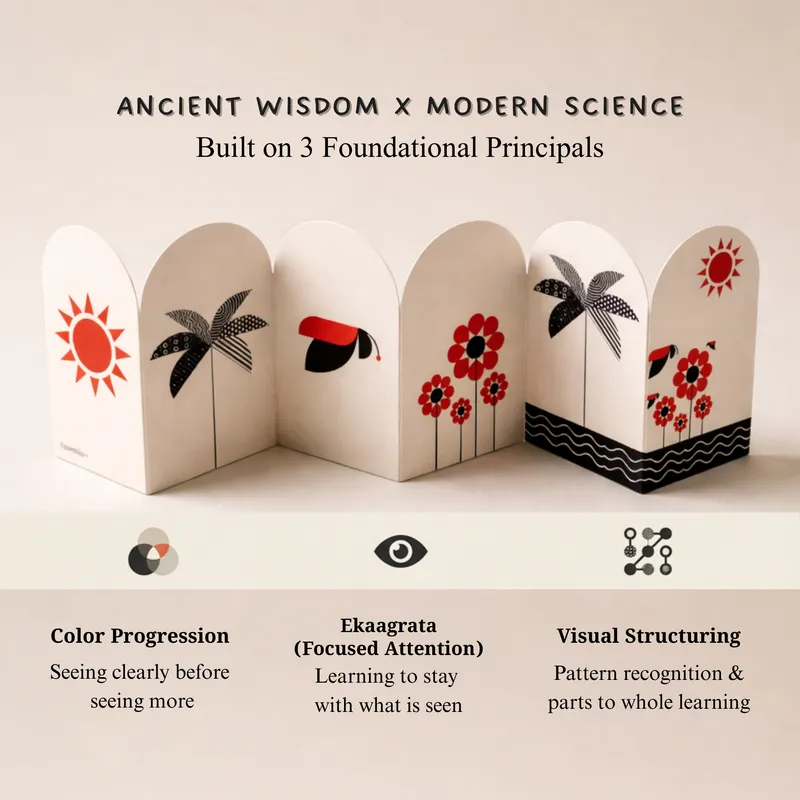
3 – 12 Months
Progressive High Contrast Cards
Two-sided progressive cards that grow with your baby — high contrast for 0–6 months, soft colours for 6–12 months. Four individual elements on each side connect in the final two leafs to form a story, training the brain to organise and connect — not just see random shapes.
$18